

Fear of judgment can silently sabotage your potential. It can keep you in a loop of self-doubt, people-pleasing, and perfectionism, even when you know you’re capable of more.
If you’ve ever felt like you have so much more to offer, but you hold back because of what others might say or think… you’re not alone.
The truth is, fear of judgment isn’t just an occasional worry; it’s a learned pattern, often starting in childhood, that can control how you show up in your career, relationships, and personal life.
Here’s the good news: you can break that pattern. You can rewire your brain and mindset, build genuine self-trust, and feel confident being exactly who you are.
Keep reading, because the shifts you’ll discover here have the power to change how you see yourself and how you live your life.
The Hidden Cost of Seeking Approval
We all want to feel accepted; it’s human. But when that need for acceptance turns into a constant chase for approval, it comes at a cost.
You stop expressing your honest opinions, avoid risks, and shape yourself to fit into other people’s expectations.
How Fear of Judgment Shapes Your Identity
People-pleasing often begins in childhood. You may have learned that getting good grades, excelling in sports, or staying quiet when there was tension at home earned you praise (or at least kept you safe).
Over time, you unconsciously built an identity around keeping the peace or meeting other people’s standards.
In adulthood, this can look like:
- Saying “yes” when you’re overwhelmed because you don’t want to disappoint anyone
- Avoiding conflict, even if it means ignoring your own needs
- Downplaying your achievements so you don’t stand out
- Silencing your ideas in meetings because you’re worried about criticism
These behaviors might feel “normal,” but they’re not neutral. They train your brain to believe: I can’t be my true self and still be accepted.
The Confidence–Validation Loop That Keeps You Stuck
When your self-worth depends on approval, you get caught in a loop:
- You work hard to please or impress others.
- Their approval gives you a temporary boost.
- Without it, your confidence drops, so you work even harder to earn it again.
This loop keeps you looking outward for validation instead of building a solid, unshakable foundation within yourself, and that’s why you keep feeling stuck in many areas of your life.
🎧 Want to dig deeper into this part of the journey? Listen to my episode Stop Being a People Pleaser for more on how these patterns start, and how to break free from them without guilt.
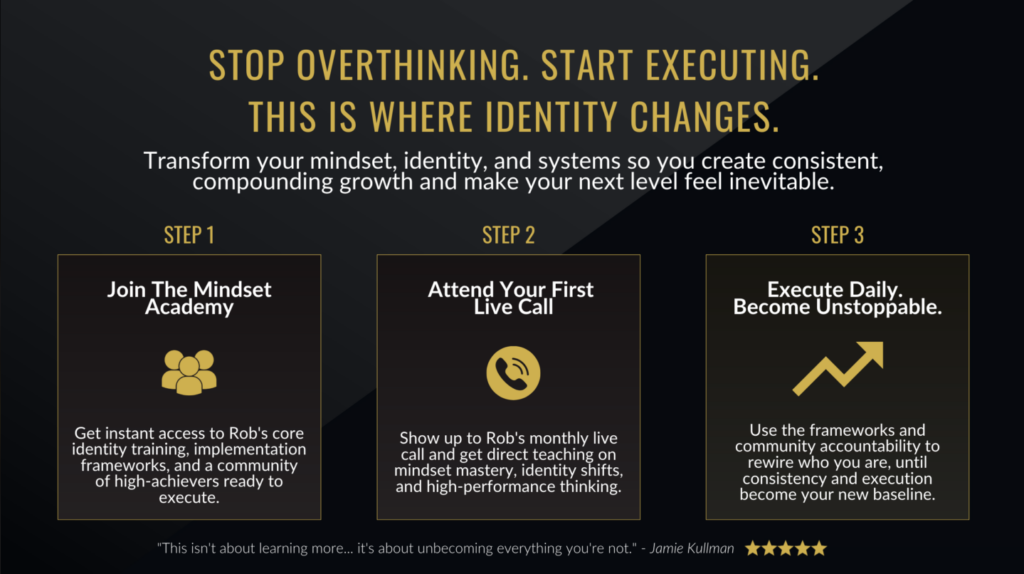
Join the Mindset Academy
Identity, Mindset, Habits. Your next level starts here.
Get your 7-day free trial and enjoy it!
Rewiring the Mindset That Holds You Back
Breaking free from fear of judgment isn’t just about “caring less”, it’s about creating a different internal system for how you see yourself.
Why Confidence Is a Skill, Not a Trait
Confidence isn’t something you’re born with; it’s something you build through action.
Every time you do what you say you’ll do (especially when it’s hard), you teach your brain: I can trust myself. That’s self-trust, and it’s the foundation of emotional resilience.
Think of it like a bank account: each small action you follow through on is a deposit. Over time, those deposits add up, and your confidence balance grows.
🎧 For a full mindset shift on this, listen to my episode Overcome the Fear of Being Judged where I break down how to separate your identity from other people’s opinions.
The Power of Self-Awareness in Breaking the Cycle
Self-awareness is your early warning system. It helps you notice when you’re about to shrink, overcommit, or silence yourself out of fear of judgment.
Example: If you find yourself rewriting an email five times before sending it, ask: Am I editing for clarity, or because I’m afraid they’ll think I’m not smart enough?
When you start catching these moments in real time, you create space to make a different choice, one that’s rooted in your values, not in fear.
And remember: nobody can hurt you with their words unless you already believe what they’re saying.
If someone’s comment hits hard, it’s because it matches an insecurity you already carry. Instead of just avoiding negative people (which helps), use those triggers as maps:
- What did that comment make me feel?
- What belief about myself did it touch?
7 Practical Steps to Overcome Fear of Judgment
You don’t overcome fear of judgment by simply “not caring.” You do it by building a stronger relationship with yourself, setting better boundaries, and creating a daily routine with habits that prove you can trust yourself. Here’s how:
1. Identify Your People-Pleasing Triggers
Before you can change a pattern, you have to see it. Fear of judgment often hides behind “being helpful” or “keeping the peace,” but the truth is you’re sacrificing your needs to avoid disapproval.
How to do it:
- For one week, jot down moments where you say yes when you want to say no, or where you hold back your opinion.
- Notice what you feel in those moments, tightness in your chest, anxiety in your stomach, that’s your cue.
Example: Your boss asks you to stay late again, even though you promised yourself you’d get to the gym. Before agreeing, ask: Am I doing this because I truly want to help, or because I’m afraid they’ll think I’m not dedicated?
2. Challenge Negative Self-Talk
Judgment only hurts when it touches a belief you already hold about yourself. The key is to stop taking every comment as truth and start questioning it.
How to do it:
- When you feel that sting, write down precisely what was said and why it bothered you.
- Ask: Is this a fact or just someone’s perspective? What evidence do I have that proves otherwise?
Example: A friend says, “You’re so quiet.” Instead of instantly thinking, They must think I’m boring, remember times you’ve been confident and engaging. You’re not “always” quiet, you’re simply reserved in certain situations.
3. Set and Communicate Boundaries Clearly
Boundaries aren’t walls to keep people out, they’re lines that protect your time, energy, and values. Without them, you’ll keep overextending yourself to earn approval.
How to do it:
- Identify the 2–3 biggest drains on your time or energy.
- Write a clear, respectful sentence you can use in those situations.
Example: “I appreciate you thinking of me for this project, but I’m at capacity right now. I want to give my best, and I can’t do that if I take on more.”
🎧 If setting limits feels impossible, listen to my episode How To Set Boundaries, I walk you through scripts and mindset shifts that make it easier.
4. Practice Saying “No” Without Over-Explaining
Over-explaining is often a sign you’re seeking permission for your decision. The more you justify, the more you invite debate.
How to do it:
- Replace “I can’t because…” with a simple “I can’t” or “I’m not available.”
- Smile, be polite, but stay firm.
Example: A friend invites you out, but you’re exhausted. Say: “Thanks for thinking of me, but I can’t make it tonight.” Stop there: you don’t need to add, “I have laundry, a headache, and three errands to run.”
5. Build Self-Trust Through Micro-Wins
Confidence isn’t built in big leaps, it’s built in small, consistent wins. Every time you keep a promise to yourself, you send your brain evidence that you can be trusted.
How to do it:
- Pick one tiny action you can do daily that matters to you (journaling, stretching, meditating, walking).
- Commit to it for 7 days, no excuses.
Example: If you promise yourself a 10-minute walk each morning, do it even if it’s raining. Over time, these “kept promises” become proof you follow through, and that proof is what builds confidence.
6. Surround Yourself With Growth-Minded People
Your environment shapes your identity. If you spend your time around people who complain, play small, or avoid growth, you’ll unconsciously start matching their energy.
But when you’re surrounded by people who challenge you, cheer for you, and hold you to a higher standard, you start to rise to it.
How to do it:
That’s why I created Mindset University, an elite community where you’re never “the only one” chasing growth.
You’ll get live coaching, recorded trainings, a powerful book club, and a group of people who get it. If you’ve been craving an environment that pulls the best out of you instead of letting you stay stuck, this is where you’ll find it.
7. Reframe Judgment as Information, Not a Verdict
Not all feedback is an attack. When you see judgment as data instead of a personal verdict, you can use it to grow without letting it crush your self-worth.
How to do it:
- When someone offers criticism, pause before reacting.
- Ask: Is there something useful here? Or is this just their taste, preference, or projection?
Example: A client says they’d prefer a different approach to your work. Instead of thinking, I’m terrible at this, consider whether their suggestion aligns with your goals, and if not, let it go.
Shifting From External to Internal Validation
Imagine walking into a room and not scanning people’s faces to see if they approve of you, because you already know you approve of yourself. That’s what happens when you shift from chasing validation to owning your worth.
When your sense of worth is anchored inside you, other people’s reactions become data, not dictators. You can hear feedback without it shaking your identity. You can receive praise without becoming dependent on it. And you can face criticism without crumbling.
Here’s what that shift looks like in action:
- Authentic self-worth → You wake up knowing you matter, without needing likes, applause, or constant reassurance. If you’re proud of the work you did, that’s enough.
- Self-acceptance → You can admit, “I made a mistake” without spiraling into “I’m a failure.” You see your flaws as part of your humanity, not as proof you’re unworthy.
- Mindset shift → When someone’s comment triggers you, instead of hiding, you ask: Why did that sting? What’s the belief underneath? That’s where growth starts.
- Confidence-building strategies → You deliberately stack small wins, like keeping promises to yourself, speaking up in a meeting, setting one new boundary, until confidence stops feeling like a performance and starts feeling like who you are.
This isn’t about becoming immune to other people’s opinions. It’s about no longer letting them decide how you see yourself.
🎧 Want to take this further? Listen to my episode Becoming Your TRUE Self for more on stripping away the conditioning that keeps you from showing up authentically.
FAQ About How to Overcome the Fear of Judgment
How do I stop caring what people think of me?
You stop caring by shifting focus from their opinion to your own standards. I ask myself, “Am I proud of this?” If yes, that’s enough. The goal isn’t zero care, it’s caring more about your truth than their judgment. That’s where freedom lives.
Why am I so afraid of being judged?
Fear of judgment often starts in childhood. We learn that approval equals safety. As adults, that turns into people-pleasing. I’ve been there, and the way out is noticing when you shrink, challenging old beliefs, and proving to yourself you can be fully you and still be okay.
What are the signs you fear judgment too much?
You might say “yes” when you mean “no,” hide opinions, or overthink every decision. I used to do all of these. They are signs you’re outsourcing your worth. Once you see them, you can start setting boundaries and building self-trust so fear stops calling the shots.
Can you really build confidence if you’ve always been insecure?
Absolutely. Confidence isn’t something you’re born with; it’s a skill. I built mine by keeping small promises to myself daily. Each win was proof I could trust myself. The more you practice, the less you’ll need outside approval to feel solid in who you are.
How do you deal with negative comments without losing confidence?
I remind myself: their words are about their perspective, not my worth. If it stings, I ask why; that’s where growth starts. Then I go back to my values and the proof of who I am. Confidence isn’t about never feeling hurt; it’s about knowing you’ll bounce back.