If you’ve ever felt like something invisible is holding you back, you’re right.
Most of the time, it’s not a lack of time, talent, or resources. It’s the story you’re telling yourself on repeat. The beliefs running in the background, quietly shaping every decision you make.
Here’s what I’ve learned: your beliefs aren’t fixed. And most of them? You didn’t even choose.
In this post, I will show you how to identify the beliefs holding you back and how to rewire them using tools backed by science and lived by experience.
What Are Limiting Beliefs?
Limiting beliefs are the subconscious stories you believe to be true, but that keep you small.
They shape how you see yourself, what you think you’re capable of, and what you believe is possible. They’re often so embedded in your thinking that you don’t even notice them.
But they’re behind the choices you make, the chances you don’t take, and the goals you quietly give up on.
A limiting belief isn’t just a thought; it’s a mental boundary. And until you challenge it, you’ll keep mistaking it for truth.
The Invisible Scripts Holding You Back
Limiting beliefs don’t always sound like fear. They sound like facts.
- “I’m not good enough.”
- “I always mess things up.
- “People like me don’t succeed.”
I used to carry a few of these myself. The worst part? I didn’t even know they were there. But they were driving every choice I made. That’s the thing about beliefs, when they go unchecked, they quietly run your life.
Where Do They Come From?
Most of your limiting beliefs didn’t start with you.
They were inherited, picked up in childhood, modeled by your caregivers, reinforced by teachers, and echoed by culture. You didn’t choose them. You absorbed them.
Let me give you two analogies I always come back to.
You’ve heard me talk about the flea in the jar. You trap a flea in a jar, screw the lid on, and it learns only to jump as high as the lid allows. Take the lid off? It still won’t jump higher, not because it can’t, but because it believes it can’t.
Now here’s another one: the horse and the chair. A massive horse, strong enough to break free, is tied to a flimsy plastic chair. But it doesn’t run because it thinks it’s still tied to something powerful. That’s what happens when conditioning overrides truth.
At some point, you stopped testing the boundary. Not because it was real, but because you believed it was.
🎧 If you’ve never heard me tell those stories before, or if they hit differently today, I dive deeper into this in this podcast episode.
You’ll learn how these invisible limits are formed, why they feel so real, and how to finally break free from the ones holding you back.
How to Identify Your Own Limiting Beliefs
Most limiting beliefs don’t sound like fear; they sound like facts. They hide inside your routines, your habits, and your self-talk. And the first step to change is catching them in the act.
Start With Self-Awareness
Awareness is the beginning of freedom.
If you want to change the belief, you must see it first. I always come back to these three questions in my own journaling:
- Where do I feel stuck?
- What do I believe about myself in that area?
- Who gave me that belief?
⚡ Want help with this? Grab my free journaling prompts, they’ll walk you through it.
Listen to Your Language
You speak your beliefs out loud every day, without realizing it.
- “I’m just bad with money.”
- “I can’t stay consistent.”
- “I’m not disciplined enough.”
Start noticing those phrases. When you hear yourself say them, pause and ask: Is that really true? Or is that just a story I’ve believed for too long?
The words you use create your identity. Let’s rewrite both.
Common Limiting Beliefs (and How to Reframe Them)
Limiting beliefs tend to follow patterns. They show up in the way we see ourselves, our potential, our money, and our relationships.
The good news? Every belief is just a story, and stories can be rewritten.
About Yourself
“I’m not disciplined.”
→ What if you’ve just been using the wrong system, one that never worked for how you operate?
“I’m too old to change.”
→ You’re not too old. You’ve just spent a long time believing that your best years are behind you.
“I’m not meant for more.”
→ Says who? You might just be living by someone else’s idea of what’s “realistic.”
About Money
“Money is bad.”
→ Money isn’t good or bad, it’s neutral. It simply reflects the heart, intention, and mindset of the person holding it.
“I’ll never be wealthy.”
→ Maybe you were never taught how to build wealth. That’s different from being incapable.
“I don’t deserve success.”
→ That’s not your voice. That’s someone else’s doubt you adopted as truth.
About Relationships
“Love always hurts.”
→ Real love doesn’t hurt. But it’s easy to confuse the two when you’ve only experienced love through pain.
“I’m better off alone.”
→ Maybe. But is that wisdom, or fear talking?
“People always leave.”
→ That might’ve happened in the past, but it’s not a universal truth. Safe relationships do exist.
About Growth and Identity
“This is just who I am.”
→ No, it’s who you learned to be. And anything learned can be unlearned.
“It’s too late to start over.”
→ Starting over isn’t a setback, it’s a conscious reset.
“I’m not smart/creative/confident enough.”
→ Not enough compared to who? Often, we measure ourselves by someone else’s highlight reel and forget our own progress.
These are just a few examples. As you go through your own beliefs, listen for thoughts that feel fixed, final, or heavy. Pause. Question them.
Ask: “Where did this come from?” and “Is this belief serving the person I want to become?”
That’s how you start breaking the loop, one story at a time.
🎧 Want to go even deeper? I break this down even more in this podcast episode, including how your limitations might be the starting line, not the stop sign. Give it a listen if you’re ready to unlock what’s been holding you back.
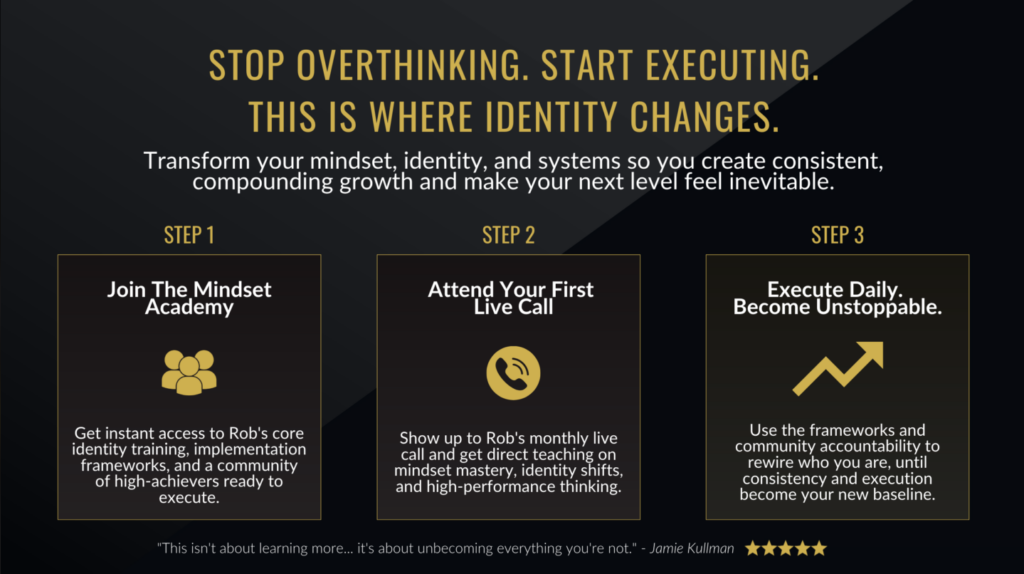
Join the Mindset Academy
Identity, Mindset, Habits. Your next level starts here.
Get your 7-day free trial and enjoy it!
The Science of Belief and Neuroplasticity
Here’s the truth: your brain is built to change.
Every thought you think, word you say, and action you take are all wiring your brain in real time. That’s called neuroplasticity.
You’ve probably heard me say this before, but it’s worth repeating: You’ve got 70 trillion volts of electricity running through you. Stop short-circuiting it with old stories.
That’s why my work — journaling, breathwork, and mindset priming — is rooted in repetition. It’s how you override the default settings and create a new path.
📩 Ready to interrupt the loop? Download my free 7-Day Self-Sabotage Recovery Plan.
4 Steps to Break Through Limiting Beliefs
Okay, I’ve shared some examples, a few mindset shifts, and even a bit of science… but let’s get practical.
What do you actually do when you notice a limiting belief holding you back?
How do you move from awareness into action and start rewiring your mind for good?
Let’s break it down into a clear, step-by-step process you can use anytime a story pops up that doesn’t serve the person you’re becoming.
1. Get the Loop Out of Your Head
You can’t shift a belief you haven’t seen. So the first step? Write it down. Get it out of your head and onto paper.
Ask yourself:
- What belief is running the show right now?
- Is it 100% true?
- What would my future self say about this?
Most of the time, the moment you question it, it loses power. That awareness alone can shift your entire day.
2. Replace the Belief With One That Serves You
Your brain doesn’t like empty space. So if you let go of a belief, you need to replace it with one that supports who you want to become.
“I always give up.”
→ “I’m the kind of person who follows through.”
“I’m not confident.”
→ “I’m building confidence one step at a time.”
But don’t just think it. Say it. Write it. Let your brain hear this new identity over and over again until it becomes familiar, and then, true.
3. Take Identity-Based Action
Beliefs need proof. So give them some.
Every small action you take becomes a vote for who you believe you are.
Want to believe you’re confident? Speak up in one meeting.
Want to believe you’re healthy? Go for a 10-minute walk today.
Your actions cast votes. Stack enough of them, and they’ll shift how you see yourself.
4. Create an Environment That Reinforces the New You
If your environment stays the same, your beliefs will too.
So look around. Who are you spending time with? What messages are you feeding your mind every morning?
Surround yourself with expanders, people who make your old beliefs feel too small. Put reminders in your space. Journal in the morning. Keep your goals where you can see them.
You become the story you tell yourself and the people you hang around.
🎯 Want help turning belief into action? Download my free Goals Mastery Guide: it’s a step-by-step framework to set goals that stick and finally follow through on what matters most.
Limiting beliefs might be invisible, but they’re not unbreakable.
Once you learn to see, challenge, and rewire them, you’re no longer stuck in the same loop.
You’re in charge now. And the story you write next? That’s up to you.
To your growth,
Rob.
Frequently Asked Questions About Limiting Beliefs
What are examples of limiting beliefs?
Limiting beliefs are negative assumptions about yourself, others, or the world. Common examples include: “I’m not good enough,” “I’ll never succeed,” or “I don’t deserve happiness.” These beliefs often stem from past experiences or cultural conditioning and can hold you back from reaching your full potential in both personal and professional life.
How do you break limiting beliefs?
To break limiting beliefs, start by identifying the thoughts holding you back. Write it down, question its truth, and replace it with a more empowering belief. Then, take consistent action that is aligned with your new belief. Over time, this process rewires your brain and reinforces your new mindset through repetition and real-world proof.
How do I identify self-limiting beliefs?
You can identify self-limiting beliefs by focusing on negative self-talk and areas where you feel stuck. Journaling prompts like “What do I believe about myself in this area?” can help uncover subconscious patterns. Listen to your language and question any thoughts that feel fixed or heavy; they often signal limiting beliefs hiding in plain sight.
What are 10 common self-limiting beliefs?
Here are ten common self-limiting beliefs:
- I’m not good enough
- I’m too old to change
- I don’t deserve success
- I’ll never be wealthy
- I’m not smart enough
- Love always hurts
- I can’t stay consistent
- People like me don’t succeed
- This is just who I am
- I’m better off alone
Where do limiting beliefs come from?
Limiting beliefs often come from early life experiences, cultural messaging, or inherited patterns from family, school, or society. They can form as a way to cope with fear or avoid failure. Even if you didn’t choose them consciously, these beliefs shape your identity until you question and intentionally replace them with more empowering ones.
Why do limiting beliefs feel so real?
Limiting beliefs feel real because they operate in your subconscious mind and influence how you interpret the world. You’ve likely reinforced them for years through repeated thoughts and experiences. But just because they feel true doesn’t mean they are. Once you bring awareness to them, you can challenge and rewire them with intention.