

If you want to understand high performance, you have to stop thinking it is just about working harder or being “more motivated.”
A real high performer has a different operating system, and it starts with one decision: I own my life.
Most people want to be a top performer, but they still live like everybody else.
They stay in reaction mode, they wait until they feel ready, and they let circumstances tell them what kind of day they are going to have.
High performers do the opposite. They decide who they are going to be, and then they execute.
And the mindset shift that flips the whole thing is what I call radical ownership.
What Radical Ownership Actually Means
Radical ownership is not self-blame. It is not you beating yourself up and saying, “Everything is my fault.” That is not power, that is punishment.
Radical ownership is power because it says: my life is my responsibility from this moment forward.
Here is the line I live by: “It might not be my fault, but it is my responsibility.”
That means your past can explain you, but it does not get to control you. You can acknowledge what happened without handing it the keys to your future.
In Mindset University (MU), one of the things I have you do is visualize where you want to be and then bring it back to action and belief.
I literally had you picture the end of the year and ask: “If you got past all of your fears, limiting beliefs, and the stories that you have of who you think you are, and you took action toward the life you wanted, what would you be celebrating?”
That’s ownership. It is you saying, “I stop negotiating with my future. I stop outsourcing my power.”
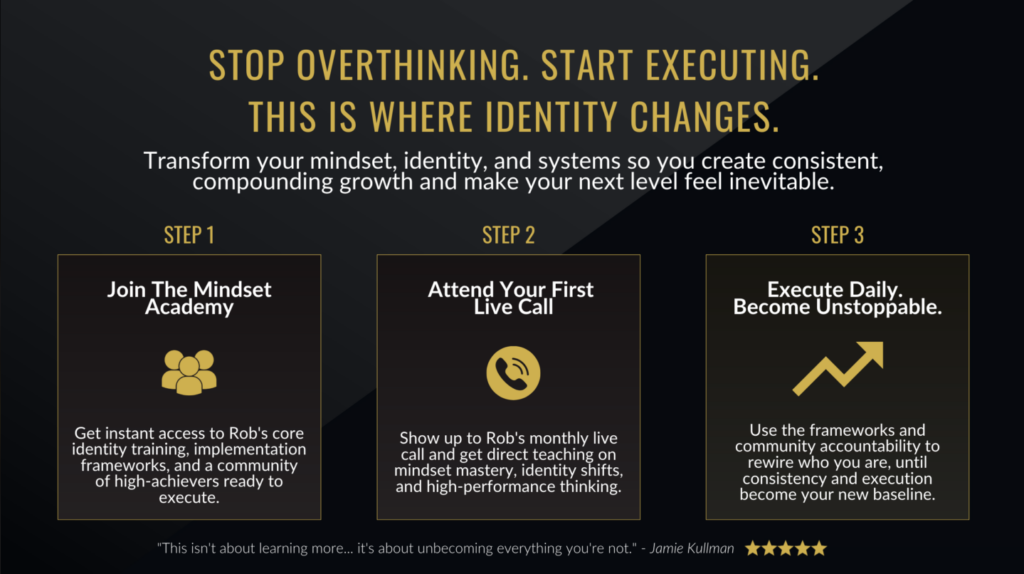
Join the Mindset Academy
Identity, Mindset, Habits. Your next level starts here.
Get your 7-day free trial and enjoy it!
Why High Performers Reject the Victim Mindset
A victim mindset feels normal because it protects your ego. It gives you a story for why you are stuck.
The problem is that it also steals the only thing that can change your life: your ability to take action.
Here is the comparison I want you to notice:
Average performer language
- “I’ll try.”
- “I’m too busy.”
- “I’ll start when I feel ready.”
- “This happened to me, so what can I do?”
High-performance mindset
- “I’ll figure it out.”
- “I act even when I’m scared.”
- “I do not wait for motivation.”
- “I design my days. I do not live in reaction mode.”
In MU, we talk a lot about how your mind loves to run to the past or the future, and how your focus shapes your outcomes.
Once we journaled about this question:
“What future do you imagine the most?” and then follow it with: “What beliefs about myself might be shaping my future, and are they helping or hindering me?”
That matters for high performance because victim thinking is a future you keep rehearsing. You keep imagining the same powerless outcome, and then you act in a way that matches it.
And this is why I say: High performers don’t make decisions based on comfort. They make them based on commitment.
The victim mindset asks, “What feels easiest right now?” The high performer asks, “What creates the result I want?”
If this idea of radical ownership is landing for you and you want to go deeper, I break this down even further in one podcast episode: The 1% Mindset, I explain how high performers stop thinking like the average person by taking full ownership, rewiring their self-talk, and building systems instead of relying on motivation.
How to Adopt Radical Ownership Daily
This is where most people mess up, because they get inspired, they feel fired up, and then they wake up the next day and go right back into reaction mode.
Radical ownership is not a speech you give yourself once, it is a practice you build into your life until it becomes your identity.
High performance is not about being perfect.
High performance is about being the type of person who follows through even when it is boring, even when it is uncomfortable, and even when nobody is clapping for you.
Step 1 — Drop All Excuses
Let me say something clearly: excuses feel safe, but they are expensive. Every excuse costs you confidence, because every time you talk yourself out of the thing, you train your mind to believe you cannot be trusted.
I know this because I used to be a professional excuse maker. I had a reason for everything. I was late, I missed the assignment, I blamed my schedule, I blamed other people, and I blamed circumstances. The truth is, I was not protecting my time, I was protecting my ego.
Radical ownership starts when you stop asking, “Who is to blame?” and you start asking, “What is my next move?”
Exercise: The Excuse Translator
Write one excuse you have been using lately, and then translate it into ownership.
- Excuse: “I’m too busy.”
- Ownership: “I am not prioritizing it, and I can decide what matters most.”
- Excuse: “I don’t feel ready.”
- Ownership: “I am nervous, and I can take one small step anyway.”
Step 2 — Become the CEO of Your Life
Here is the mindset shift: you cannot keep acting like an employee in your own life and expect CEO-level results.
The moment that changed my life was when my coach broke it down for me like this: if a business wins, it is the CEO’s responsibility, and if a business fails, it is the CEO’s responsibility. Then he said the line that hit me in the chest:
“Your problem, Rob, is that you’re not living like you’re the CEO of your life.”
And he was right.
CEO energy is not self-blame. CEO energy is decision-making.
It is you saying, “I will stop waiting for someone to rescue me, and I will start leading myself.”
A CEO does not wake up and hope the business runs itself.
A CEO has a plan, has priorities, and makes the important things non-negotiable.
In MU, I talk about how humans want change right now, but real change comes from showing up consistently and making it a non-negotiable to do the work.
That is why I tell people that if they just keep showing up and doing what they are supposed to do, the shift compounds over time.
Exercise: The CEO Decision
Ask yourself this question and answer it in one sentence:
- “If I was the CEO of my life, what would I do today that I am currently avoiding?”
Then do the smallest version of it today. CEOs do not wait for perfect conditions; they execute with what they have.
Step 3 — Replace Comfort-Based Decisions With Commitment-Based Decisions
This is the separator.
Average performers negotiate with their goals. They negotiate with their feelings. They negotiate with discomfort.
High performers do not do that. High performers decide, and then they follow through.
Here is the truth: if you make decisions based on comfort, you will create a comfortable life that you secretly resent.
If you make decisions based on commitment, you will create a life you are proud of.
High performers don’t make decisions based on comfort; they make them based on commitment.
And this is where systems come in, because most people think high performance is willpower. It is not. Willpower is unreliable. Systems are reliable.
Willpower is for amateurs. High performers build systems.
So let me give you three simple systems that turn radical ownership into daily routine behavior.
System 1: A simple morning routine (10 minutes)
High performance starts with how you enter the day. If you wake up reactive, your whole day becomes a fire drill. If you wake up intentionally, you lead yourself.
Do not overcomplicate this. You do not need 15 habits. You need a short routine that reminds you who you are.
Here is a simple one:
- 2 minutes: breathe slowly and get into your body
- 3 minutes: write what matters most today
- 5 minutes: move your body, even if it is just stretching
The point is not the routine. The point is identity. You are training your mind to say, “I lead my day. My day does not lead me.”
System 2: Weekly planning (20 minutes, once a week)
If you do not plan your week, you will live inside everybody else’s plans.
Once a week, pick a time and make it sacred. Sunday night or Monday morning both work. You write:
- Your top outcomes for the week
- The main needle-movers (not a mile-long list)
- The days you will do the hard things
This is also where you tie it to identity. You are not just planning tasks. You are planning the version of you that you are becoming.
System 3: Daily non-negotiables (2–3 items)
Most people have a long to-do list and feel productive because they checked off easy stuff.
High performers pick two or three needle-moving items and do not stop until they are done.
If you want radical ownership, you need daily proof. Proof builds trust. Trust builds confidence. Confidence builds high performance.
Exercise: The Non-Negotiable List
Write your 2–3 non-negotiables for tomorrow. Make sure they are:
- Small enough to do even on a bad day
- Important enough to move your life forward
Then you keep your word to yourself. That is how you become a high performer.
In How To Get Ahead Even When No One Is There For You, I walk you through how the top 1% rise anyway — even without support — by mastering discipline, long-term thinking, and habits that compound behind closed doors. If you are serious about high performance, this episode will help you turn this mindset into daily action.
Radical Ownership Changes Everything If You Practice It
Radical ownership is not a personality trait. It is not something you are born with or without. It is a daily decision.
It is the choice to stop waiting for life to feel easier and to start showing up as the person who creates results no matter what.
High performance is not about doing more.
It is about making decisions from commitment instead of comfort. It is about building systems instead of relying on motivation.
And most importantly, it is about taking full responsibility for the direction your life is going in.
That is the difference between someone who stays inspired for a week and someone who actually becomes a high performer.
People Also Ask
What is radical ownership?
Radical ownership is the decision to take full responsibility for your life from this moment forward. It does not mean everything is your fault, but it does mean your future is your responsibility. When you own your actions, your mindset, your habits, and your choices, you stop being reactive and you become proactive.
How does taking responsibility improve success?
Because responsibility gives you control. If it is always someone else’s fault, then you are powerless, and powerless people do not create high-performance results. When you take responsibility, you immediately gain options, and options create change.
How do high performers overcome excuses?
High performers overcome excuses by building systems that remove decision fatigue. They do not rely on motivation. They create a morning routine that primes them, weekly planning that keeps them focused, and daily non-negotiables that prove they follow through. Then they use self-inquiry to catch the old stories before they turn into old behavior.